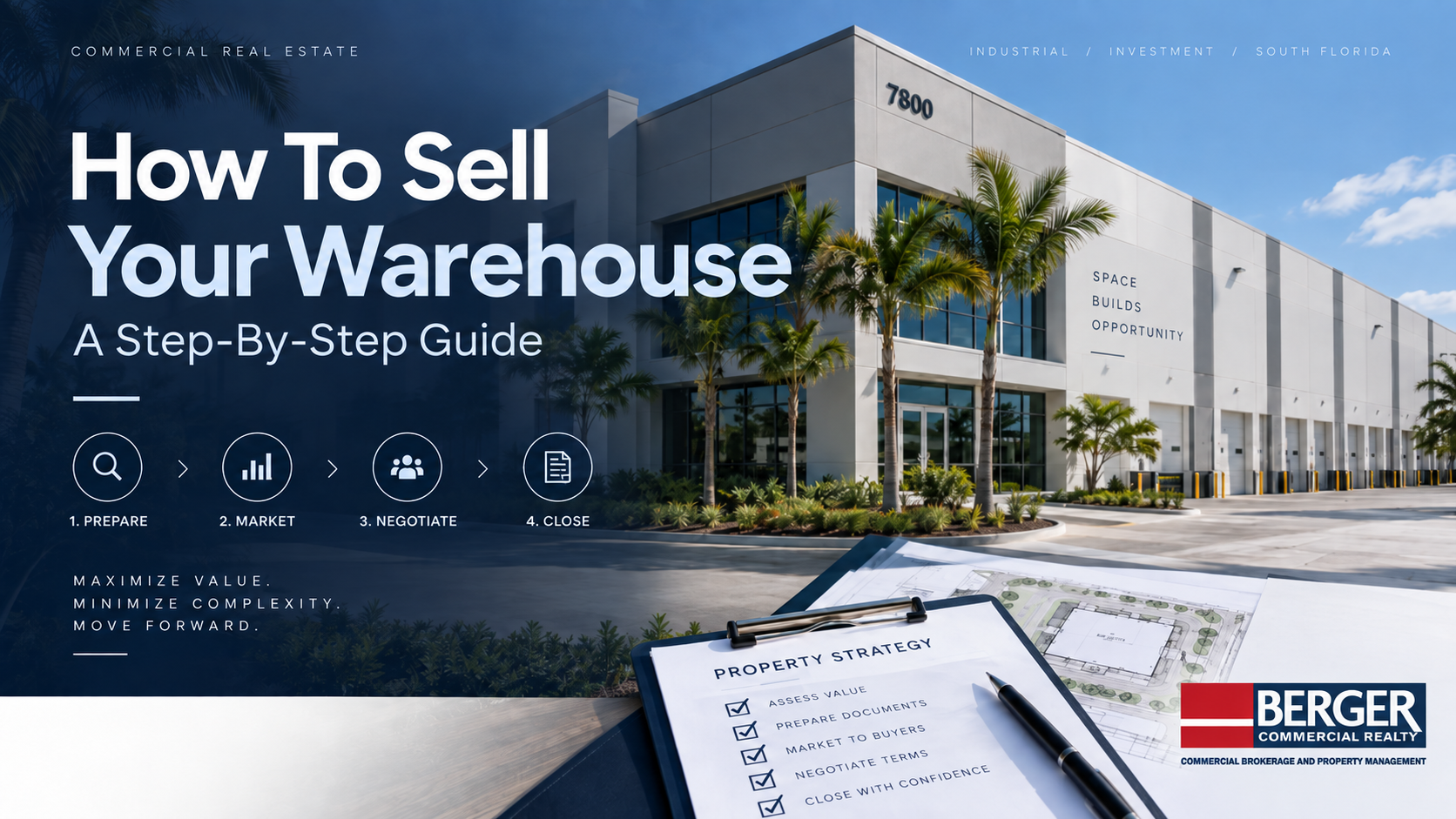
If you are asking "How do I sell my warehouse?", the most important first step is not putting the property on the market. It is determining what the warehouse is worth, which buyers are most likely to want it, and how the property should be positioned to maximize value.
Berger Commercial Realty represents owners selling warehouses, industrial buildings, flex properties, distribution facilities and industrial land throughout Broward, Miami-Dade and Palm Beach counties.
A 5,000-square-foot owner-user warehouse in Fort Lauderdale should not necessarily be marketed the same way as a 100,000-square-foot distribution facility in Pompano Beach or a fully leased industrial investment in Palm Beach County.
The goal is not simply to find a buyer. The goal is to identify buyers most likely to recognize the property's value and create enough market interest to produce the strongest combination of price, terms and certainty of closing.
What Is Your Warehouse Worth?
Berger Commercial Realty can prepare a complimentary Broker Opinion of Value and evaluate the buyer groups, comparable sales and market conditions affecting your property.
Request a Complimentary Warehouse ValuationHow to Sell a Warehouse: 7 Steps
- Determine the warehouse's current market value.
- Choose the right sale structure and buyer strategy.
- Prepare the property and due diligence documents.
- Hire a broker experienced in industrial real estate.
- Market the warehouse to qualified owner-users and investors.
- Compare offers based on price, terms and probability of closing.
- Complete inspections, environmental review, title work and closing.
Each step can affect the final sale price. This is particularly important in South Florida, where industrial property values can vary substantially between submarkets and even between properties located only a few miles apart.
1. Determine What Your Warehouse Is Worth
Before establishing an asking price, determine how buyers are likely to value your warehouse.
An experienced industrial real estate broker can prepare a Broker Opinion of Value (BOV) considering recent comparable sales, competing listings, building specifications, income, lease structure, zoning, land value and current buyer demand.
Owners may also find our guide to determining warehouse value in Fort Lauderdale helpful.
How Is an Owner-Occupied Warehouse Valued?
Owner-user buyers often focus on comparable sales and price per square foot. However, price per square foot alone does not tell the entire story.
Buyers also evaluate clear height, loading, electrical power, parking, truck access, warehouse-to-office ratio and zoning. A property's functionality can strongly influence demand.
How Is a Leased Warehouse Valued?
For a warehouse occupied by tenants, investors typically analyze the income generated by the property in addition to comparable sales.
Factors include net operating income, lease expiration dates, rent compared with market rates, annual increases, renewal options, tenant credit and landlord responsibilities.
How Is an Industrial Property With Extra Land Valued?
For warehouses with outside storage, excess land or redevelopment potential, land value may represent a significant portion of the property's overall value.
Zoning, permitted outdoor storage, expansion opportunities, access and redevelopment potential should be evaluated before setting an asking price.
Can I Sell My Warehouse and Continue Operating My Business There?
Yes. A sale-leaseback allows a business owner to sell the real estate to an investor and simultaneously lease the property back for an agreed period.
A sale-leaseback may allow a business to unlock capital tied up in its real estate while continuing operations at the same location.
What Factors Affect the Value of a Warehouse?
Two warehouses with identical square footage can have significantly different values. Industrial buyers evaluate how efficiently a property supports operations, generates income or accommodates future growth.
| Factor | Why It Matters |
|---|---|
| Location | Access to I-95, I-595, Florida's Turnpike, major roads, airports and ports can influence buyer demand. |
| Clear Height | Higher clear heights may improve storage and racking efficiency. |
| Loading | Dock-high and grade-level loading determine which businesses can efficiently use the building. |
| Truck Access | Truck court depth, turning radius and circulation are particularly important to distribution users. |
| Electrical Power | Power capacity can be important for manufacturing and specialized operations. |
| Parking | Employee, customer and fleet parking requirements vary by business. |
| Building Condition | Roof, HVAC, structural systems, fire protection and maintenance may affect pricing and negotiations. |
| Zoning | Permitted uses can expand or limit the potential buyer pool. |
| Outside Storage | Permitted outdoor storage can increase value for certain industrial and automotive users. |
| Lease Structure | Rent, tenant quality, remaining lease term and rollover risk influence investor pricing. |
A credible warehouse valuation should evaluate these factors together rather than rely on one generalized price-per-square-foot figure.
What Is Happening in the South Florida Industrial Market?
Owners considering selling a warehouse should evaluate current conditions within their property's specific submarket rather than rely exclusively on national trends.
Broward County Industrial Market
Berger Commercial Realty's Q2 2026 Broward County Industrial Market Report reported approximately 118.4 million square feet of industrial inventory, a 6.7% vacancy rate, a 5.9% availability rate and average asking rents of $17.44 per square foot.
Palm Beach County Industrial Market
Berger's Q2 2026 Palm Beach County Industrial Market Report reported approximately 56.6 million square feet of industrial inventory, an 8.0% vacancy rate, a 7.1% availability rate and average asking rents of $15.32 per square foot.
These figures reinforce an important consideration for warehouse sellers: pricing and positioning matter.
An asking price that cannot be supported by comparable sales, property income or physical advantages may cause a listing to remain on the market while appropriately positioned properties attract stronger interest.
If you are deciding whether to sell or hold, read our guide on when to sell a commercial property.
2. Choose the Right Strategy for Selling Your Warehouse
Not every warehouse should be marketed in the same way. Some property owners prioritize maximum exposure and competitive bidding. Others prioritize confidentiality, speed, continued occupancy or a particular closing timeline.
Publicly Marketed Warehouse Sale
A broadly marketed sale can expose the property to local, regional and national buyers. Broad exposure may create competitive interest when several qualified parties recognize the property's value.
Off-Market Warehouse Sale
An off-market approach may make sense when confidentiality is particularly important or when a broker can identify a targeted group of prospective buyers.
However, limiting exposure can also limit price discovery. An experienced broker should discuss the advantages and tradeoffs before recommending this strategy.
Owner-User Versus Investor Strategy
The most likely buyer depends partly on occupancy. A vacant warehouse may attract businesses seeking space for their operations, while a fully leased property may appeal to investors seeking income.
Properties with below-market leases, excess land or redevelopment potential may attract additional buyer categories.
3. Prepare Your Warehouse for Sale
You do not necessarily need to renovate an industrial building before placing it on the market. In many cases, addressing issues that could reduce buyer confidence or create unnecessary due diligence complications is more practical.
Physical Preparation
- Clean the warehouse, office and exterior areas.
- Remove unnecessary debris and stored materials where possible.
- Address obvious leaks and visible deferred maintenance.
- Confirm loading doors and major systems are accessible for inspection.
- Organize occupied areas to show the building's functionality.
- Consider professional photography and aerial imagery.
Documents to Gather Before Selling
- Property survey and legal description
- Title information
- Existing leases and amendments
- Rent roll, if applicable
- Operating expense records
- Property tax information
- Environmental reports
- Roof and HVAC information
- Building plans and site plans
- Certificates of occupancy or use documentation
- Service contracts and warranties
- Records of recent capital improvements
Organizing these materials before a buyer enters due diligence can help reduce delays and avoid unnecessary questions during the transaction.
4. Choose an Industrial Real Estate Broker
Selling a warehouse is different from selling residential real estate and from selling many other commercial property types.
An experienced industrial real estate broker understands how buyers evaluate loading, clear height, electrical power, truck circulation, zoning, outside storage, building functionality, environmental conditions and lease economics.
Just as importantly, that broker should understand the active buyer pool in your South Florida submarket.
Questions to Ask a Warehouse Broker
- What do you believe my warehouse is worth, and why?
- Which comparable sales support that valuation?
- Who are the most likely buyers for my property?
- Should the property be marketed publicly or privately?
- How will you reach qualified industrial buyers?
- What industrial properties have you sold recently?
- How will you compare offers and manage negotiations?
Berger Commercial Realty's commercial real estate brokerage team represents property owners, investors and businesses throughout South Florida.
You can also review our South Florida commercial real estate brokers and their specialties.
5. Market the Warehouse to the Right Buyers
Effective warehouse marketing should do more than place an industrial property on listing websites.
The marketing campaign should communicate why the property is valuable, what makes it different and which buyers can benefit most from owning it.
Depending on the property, an industrial real estate marketing campaign may include:
- Professional property photography
- Drone and aerial imagery
- Offering memorandums and brochures
- Dedicated property websites
- Targeted email campaigns
- Direct outreach to businesses with matching space requirements
- Broker-to-broker marketing
- Commercial real estate listing platforms
- Social media and digital advertising
- Property signage
- Investor and owner-user prospecting
Platforms such as CoStar, LoopNet and Crexi can provide important exposure, but public listings are only one part of an effective campaign.
Direct outreach to qualified industrial users, investors and brokers with active requirements can be equally important.
How Does Berger Commercial Realty Market Industrial Properties?
An effective industrial sale strategy begins with identifying the property's most competitive features and determining which buyer groups are most likely to value them.
Depending on the assignment, Berger Commercial Realty can combine direct buyer outreach, broker relationships, professional marketing materials, commercial property listing platforms, digital marketing and targeted prospecting to generate interest from qualified buyers.
Marketing strategies should also reflect the owner's objectives, whether those involve maximizing exposure, maintaining confidentiality, accommodating existing tenants or coordinating a sale with business operations.
6. Evaluate Warehouse Offers Beyond the Purchase Price
The highest offer is not always the strongest offer.
When multiple offers are received, sellers should evaluate the complete proposal rather than focus solely on the headline purchase price.
Important considerations include:
- Purchase price
- Earnest money deposit
- Financing requirements
- Due diligence period
- Closing timeline
- Appraisal contingencies
- Environmental contingencies
- Required seller repairs or credits
- Buyer experience and financial capacity
- Probability of closing
A slightly lower offer with strong financial capacity, meaningful earnest money and fewer contingencies may present a different risk profile than a higher offer with extensive financing requirements.
Your broker can help compare Letters of Intent and purchase proposals so you understand both the economic value and execution risk of each offer.
7. Complete Due Diligence and Close the Sale
Once a purchase contract is executed, the buyer typically begins formal due diligence.
Depending on the property, this process may include:
- Physical property inspections
- Phase I environmental assessment
- Title review
- Survey review
- Zoning verification
- Roof and building-system inspections
- Lease review
- Appraisal
- Financing approval
The broker helps coordinate communication among the seller, buyer, attorneys, title company, lender and other professionals while keeping the transaction moving toward closing.
Property owners should consult their attorney and tax advisor regarding legal and tax implications.
Recent Industrial Property Sales by Berger Commercial Realty
Berger Commercial Realty has facilitated industrial real estate transactions throughout South Florida and the Treasure Coast, including individual properties and multi-building industrial portfolios.
Our transaction experience spans a variety of property sizes, locations and price points. The following completed sales illustrate Berger Commercial Realty's experience in the industrial real estate market.
| Property Address | City | Sale Price |
|---|---|---|
| 5801–5897 SW 21st Street | West Park, FL 33023 | $47,250,000 |
| 3330 NW 53rd Street | Fort Lauderdale, FL 33309 | $13,750,000 |
| 5450 NW 33rd Avenue | Fort Lauderdale, FL 33309 | $11,800,000 |
| 645 NW Enterprise Drive | Port St. Lucie, FL 34986 | $8,900,000 |
| 7051 SW 21st Place | Davie, FL 33317 | $4,200,000 |
| 705 NW 8th Avenue | Fort Lauderdale, FL 33311 | $3,600,000 |
| 437 NW 1st Avenue | Fort Lauderdale, FL 33301 | $2,200,000 |
| 900 NE 2nd Avenue | Fort Lauderdale, FL 33304 | $1,400,000 |
| 3034 NE 12th Terrace | Oakland Park, FL 33334 | $1,349,000 |
Industrial Sales Experience Across Multiple Price Points
These transactions illustrate Berger Commercial Realty's experience in markets including Fort Lauderdale, West Park, Davie, Oakland Park and Port St. Lucie.
Industrial property owners may have different selling objectives depending on the size, condition, occupancy and intended use of their properties.
Smaller industrial buildings may appeal to owner-users seeking facilities for business operations, while larger buildings and portfolios may attract private investors and institutional buyers.
Understanding the differences between these buyer groups is an important part of positioning an industrial property for sale.
Featured Industrial Sale: $47.25 Million West Park Portfolio
Berger Commercial Realty Senior Vice President Jordan Beck represented the seller in the $47.25 million sale of a six-building industrial portfolio in West Park, Florida.
The transaction involved approximately 228,000 square feet of industrial space across more than nine acres.
The off-market sale demonstrates Berger's experience representing industrial property owners in substantial portfolio transactions and working with qualified buyers.
Featured Industrial Sale: Oakland Park Warehouse
Berger Commercial Realty Senior Vice President R. Stephen Hyatt represented the seller in the $1,349,000 sale of a 5,867-square-foot industrial warehouse in Oakland Park, Florida.
The transaction demonstrates Berger's experience representing sellers of smaller industrial properties in addition to larger industrial buildings and investment portfolios.
What Do Recent Industrial Sales Mean for Your Warehouse?
Recent industrial sale prices provide valuable market context, but they should not be treated as direct valuation estimates for another property.
Warehouse values depend on factors including building size, location, clear height, loading configuration, occupancy, lease income, zoning, land area, physical condition and buyer demand.
A meaningful valuation should consider relevant comparable transactions while accounting for the specific characteristics of your property.
Berger Commercial Realty can help owners evaluate these factors and determine an appropriate pricing and marketing strategy.
Frequently Asked Questions About Selling a Warehouse
How long does it take to sell a warehouse?
There is no reliable one-size-fits-all timeline. Location, building size, asking price, condition, occupancy, buyer financing and market demand all affect the time required to sell. Ask your broker to review comparable transactions in your specific submarket.
Can I sell a warehouse that is currently leased?
Yes. A leased warehouse can be attractive to investors because it produces rental income. Buyers generally evaluate rent relative to market rates, remaining lease term, renewal options, tenant credit and landlord obligations.
Can I sell my warehouse while my business is operating there?
Yes. Your business can generally continue operating while the property is marketed. You may relocate after closing, deliver the property vacant or negotiate a sale-leaseback allowing your business to remain in the building.
Can I sell my warehouse off market?
Yes. An off-market sale can be appropriate when confidentiality is important or a broker has identified a specific group of qualified buyers. However, limiting exposure may reduce competitive price discovery, so both approaches should be evaluated.
Should I make repairs before selling my warehouse?
Not necessarily. Sellers should prioritize repairs or maintenance issues that could materially affect buyer confidence, inspections or negotiations. Major renovations should be evaluated against the likely increase in sale value.
What is a Broker Opinion of Value?
A Broker Opinion of Value (BOV) is a broker's analysis of a property's likely market value using comparable sales, competing listings, property specifications, income, lease structure and current buyer demand.
A BOV can help an owner decide whether to sell, hold, refinance or reposition a property. It is different from a formal appraisal performed by a licensed appraiser.
Do I need a commercial real estate broker to sell my warehouse?
Property owners can sell commercial real estate without a broker. However, industrial transactions often require specialized expertise involving valuation, buyer sourcing, marketing, negotiations, environmental review, inspections and closing.
An experienced industrial broker may also provide access to qualified buyers who would not discover the property through public listing platforms alone.
What is the best way to sell my warehouse?
The best approach begins with determining the property's market value and identifying the buyer category most likely to recognize its potential. From there, your broker can determine whether broad marketing, targeted outreach or an off-market strategy is appropriate.
Who buys warehouses in South Florida?
Potential buyers include local businesses, manufacturers, distributors, logistics companies, automotive users, private investors, family offices, developers, real estate investment firms and institutional investors.
The likely buyer pool depends on the property's size, location, occupancy, zoning, physical characteristics and price.
How much does it cost to sell a warehouse?
The costs associated with selling an industrial property depend on the property's condition, transaction structure and negotiated agreement. Potential expenses may include brokerage commissions, legal fees, title-related costs, property repairs, closing adjustments and applicable taxes.
Before listing a warehouse, owners should review anticipated selling expenses with their broker, attorney and tax advisor to better understand potential net proceeds.
How can I find out what my warehouse is worth?
A commercial real estate broker experienced in industrial properties can prepare a Broker Opinion of Value using recent comparable sales, competing properties, building specifications, lease income, occupancy and local buyer demand.
Berger Commercial Realty offers complimentary warehouse valuation consultations for qualifying commercial property owners in South Florida.
Thinking About Selling Your Warehouse?
If you own a warehouse, flex building, distribution facility, industrial investment property or industrial land in South Florida, you do not have to begin by listing it.
Start by finding out what your property is worth and which buyers are most likely to want it.
Berger Commercial Realty can prepare a complimentary Broker Opinion of Value and discuss potential sale strategies for your property.
Request a Complimentary Warehouse ValuationFort Lauderdale: 954.358.0900
Palm Beach: 561.613.0900